Column · @practicalinference
What to Look for When Comparing Low-Cost LLM API Options
Understanding the Real Cost of an LLM API
When you start shopping for a low cost LLM API, the first thing you notice is how many providers there are. Each one has a price list, but comparing them is rarely straightforward. The headline numbers on a pricing page often hide the details that determine your actual bill at the end of the month. This article walks through the key points to check so you can make an honest comparison between different LLM API offerings.
1. Check the Pricing for Input and Output Tokens Separately
Most LLM APIs charge different rates for input tokens (the text you send to the model) and output tokens (the text the model generates). Some providers charge a premium for output tokens, which can be two or three times the input rate. When you scan a price list, do not just look at the smallest number. Look at both columns. A model that looks cheap on input may be expensive on output, and if your application generates long responses, that difference adds up fast. For example, a chatbot that produces detailed answers will spend most of its token budget on output. An API that charges the same rate for both directions can be more predictable, even if its input price is slightly higher.
2. Understand the Difference Between List Price and Effective Price
The list price a provider advertises is rarely what you actually pay. Many APIs offer volume discounts, caching discounts, or lower rates for off-peak hours. Some providers charge a flat monthly fee that includes a certain number of tokens and then a per-token rate above that. Others have no monthly fee but charge a higher per-token rate. To compare effectively, you need to estimate your typical request volume and the average number of tokens per request. A service with a low list price but a high minimum spend might end up costing more for a small project, while a service with a slightly higher list price but no minimum could be the cheaper option for light usage.
3. Look for Usage Limits and Rate Throttles
A low price per token means little if the API caps your usage at a level too low for your application. Some providers offer generous rate limits on their paid plans, while others restrict the number of requests per minute or the number of tokens per day. If you plan to run a production application, check the fine print on rate limits and concurrency. A service that throttles you after a few hundred requests can ruin the user experience. Also check whether the provider charges extra for higher rate limits or whether they are included in the base price. Some APIs offer a "pay-as-you-go" model where you can increase your rate limit by paying a higher per-token price, which might still work out cheaper than a flat monthly fee from a competitor.
4. Evaluate the Cost of Monitoring and Billing Overhead
Token pricing is only part of the story. The time you spend monitoring usage, tracking costs, and reconciling bills also has a real cost. Some providers offer detailed dashboards that break down token usage by model, by endpoint, and by time period. Others give you a single number at the end of the month. If you need to track costs across multiple projects or departments, a provider with granular billing data can save you hours of manual work. Also check how the provider handles billing balance. Does it send alerts when you approach a spending limit? Can you set hard caps to prevent surprise bills? These features may not appear on a price list, but they affect the total cost of running an LLM API in practice. A low price per token can be offset by the administrative friction of a poorly designed billing system.
5. Consider the Trade-Off Between Price and Model Quality
The cheapest LLM API is not always the best value. A very low price per token might come from a smaller, older, or less capable model. If that model produces lower-quality output, you may need to spend extra tokens on prompt engineering, multiple retries, or human review. In some cases, paying a bit more for a newer, more capable model reduces your total cost because you get better results in fewer attempts. The key is to test the actual output quality for your use case before committing to a low-cost provider. Run a batch of representative requests through the API and evaluate the results. If the cheap model makes errors that a slightly more expensive model avoids, the extra cost per token may be worth it. On the other hand, for simple tasks like classification or short-form generation, a low-cost model might perform just as well as a premium one.
6. Watch for Hidden Fees and Structural Costs
Some LLM API providers charge extra fees that are not obvious from the per-token price. For example, there may be a fee for storing conversation history, for using certain advanced features like function calling, or for accessing the model via a custom endpoint. Other providers include all features in the per-token price. Before you sign up, read the terms of service and the documentation for the features you plan to use. A provider that looks cheap on the surface might become expensive once you add the features your application needs. Also check whether the provider charges for failed requests or for requests that return an error. Most do not, but a few do, and that can add unexpected cost during development and testing.
7. Compare the Overall Developer Experience
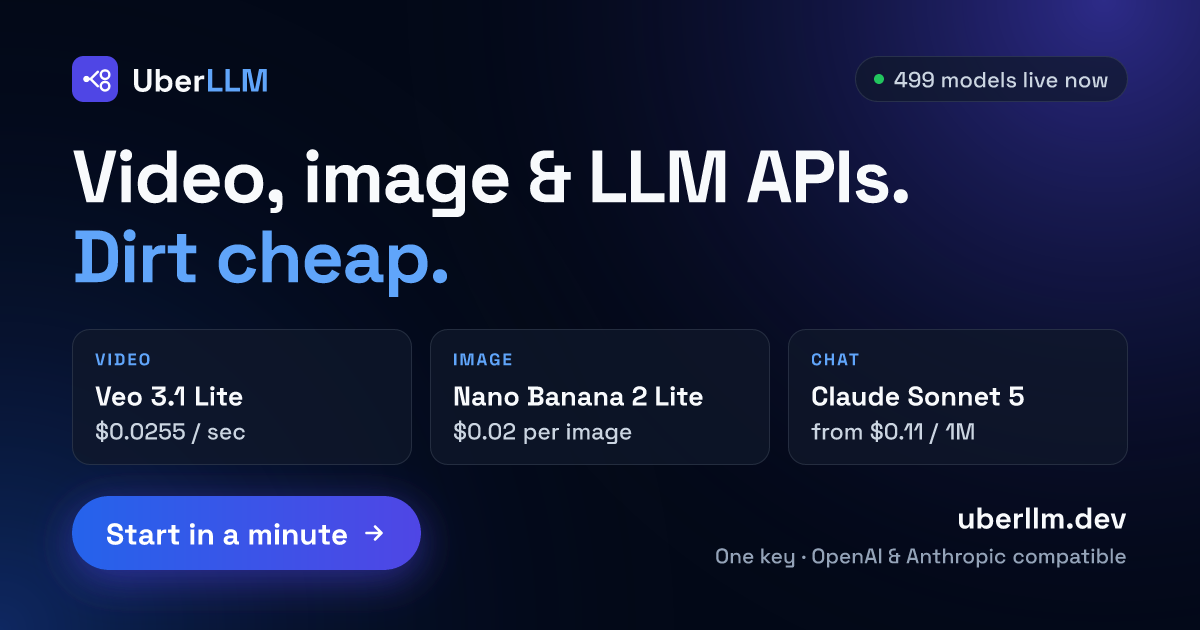
Finally, consider how easy it is to integrate and maintain the API. A low-cost API that requires complex authentication, custom SDKs, or manual retry logic can slow down development and increase maintenance costs. A provider with a clean, well-documented API and good client libraries saves time and effort. That time and effort has a dollar value. If you are building a product that depends on LLM calls, the developer hours spent on integration and debugging can easily exceed the cost of the tokens themselves. A provider like uberllm.dev simplifies this by offering a single compatible endpoint that works with existing OpenAI and Anthropic clients, reducing the integration work. When you compare APIs, factor in the setup time and the ongoing maintenance burden. A slightly higher per-token price from a provider with a smooth developer experience may be the cheaper option when you count total cost of ownership.
8. Build a Simple Spreadsheet Before You Commit
With all these factors in mind, the most practical step is to build a simple spreadsheet. Estimate your average number of requests per day, the average input token count per request, and the average output token count per request. Then plug in the per-token rates from each provider you are considering. Add columns for any monthly fees, volume discounts, and expected monitoring overhead. Run the numbers for low, medium, and high usage scenarios. You might find that one provider is cheapest for light usage while another wins for heavy usage. The spreadsheet makes the trade-offs visible and helps you choose the low cost LLM API that actually fits your application. Do not rely on a single number from a comparison site or a blog post; your usage pattern is unique, and the right choice depends on your specific balance of input, output, and volume.
9. Keep an Eye on the Market
LLM token pricing changes frequently. New providers enter the market, existing ones adjust their rates, and model capabilities improve. A low-cost API that makes sense today might be outdated in six months. Set a reminder to review your API costs every quarter. Check whether newer, cheaper models have been released. Look at your actual usage data to see if your pattern has shifted. A low cost LLM API is not a one-time decision; it is an ongoing choice. By staying aware of the market and reviewing your costs regularly, you ensure that you are always getting the best value for your use case. Services like uberllm.dev can help by aggregating multiple model providers through a single API, making it easier to switch between models without changing your integration. You can test different providers and compare their output quality and pricing without rewriting your code each time.
Putting It All Together
Comparing LLM API prices is more than scanning a column of numbers. You need to look at input and output rates separately, understand the effective price after discounts and limits, account for monitoring and billing overhead, and factor in model quality and developer experience. A structured checklist makes the process systematic and reduces the chance of missing a hidden cost. The goal is not to find the absolute cheapest per-token rate, but to find the provider that gives you the best total value for your specific application. With a clear comparison method, you can choose a low cost LLM API that keeps your costs predictable and your application running smoothly.